
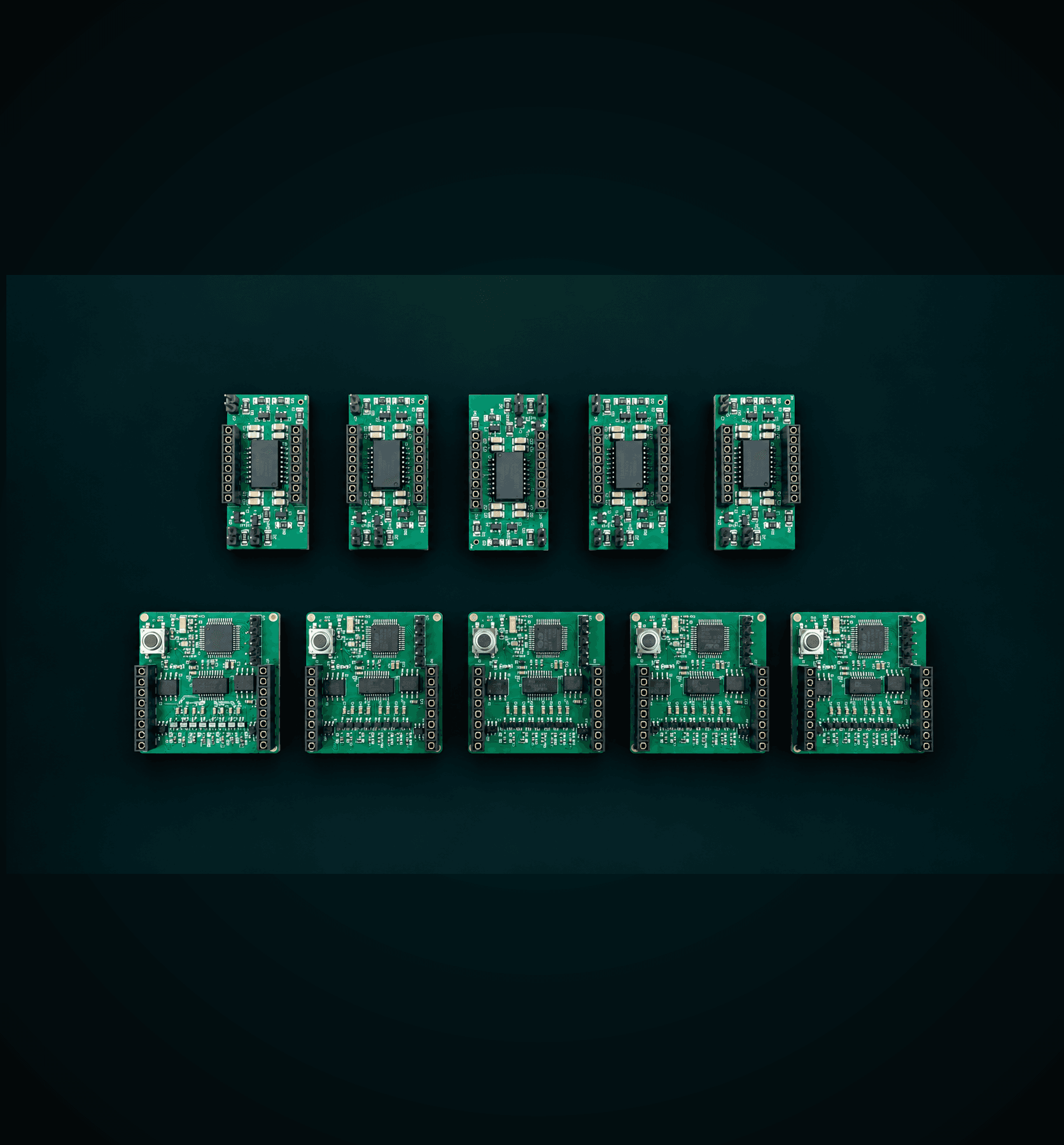
Designing an isolated RS-485 communication board to extend a client's platform onto the plant floor
Challenge
Beyond reading sensors and driving actuators, the same client's control platform needed to talk to third-party industrial equipment over RS-485 - the serial standard used across countless PLCs, drives, and instruments on a plant floor - and needed that link to survive the electrical noise and ground-potential differences common in that environment, while staying consistent with the I2C-addressable interface boards already in their system.
Solution
We designed a third module in the same interface-board family, this one built around Analog Devices' ADM2682: a fully isolated RS-485 transceiver with an integrated isolated DC/DC converter, so the RS-485 side of the board has no direct electrical connection back to the client's control system, protecting it from ground loops, with the same ADM2682 also giving the bus lines +/-15kV ESD protection - which matters on a factory floor where cable runs pick up transients from nearby motors and switching equipment. The board supports both half-duplex (2-wire) and full-duplex (4-wire) RS-485 wiring so it can be matched to whatever third-party equipment it's talking to, with the same STM32C031C6T6 microcontroller used across the rest of the board family handling framing and control and exposing the interface to the client's master controller over I2C - so a system that already knew how to talk I2C to the analog input and output boards picks up RS-485 connectivity without learning a new integration pattern. Laid out in Altium to the same compact module footprint as its siblings, it drops into the same enclosure alongside them.
Results
The result is a third, electrically isolated interface module that extends the client's control platform onto the RS-485 devices already common on an industrial floor, without exposing the rest of their system to the noise and ground-potential swings that come with that environment. Because it shares its MCU, its I2C integration pattern, and its physical form factor with the input and output boards before it, the client now has a small family of interface modules - sensor input, actuator output, and RS-485 communication - that all integrate the same way, so adding the next one is a known quantity rather than a new design exercise.
Kick-start your project
Get in touch with our team to discuss your business needs and see how we can help with a project like this one.