
Designing a wireless pedestrian crossing button that meshes with its intersection
Challenge
The same client's traffic-signal platform needed a pole-mounted pedestrian push-button for requesting a walk signal that didn't depend on a dedicated wired data run back to the controller, that could reliably reach the controller from wherever it was mounted on the corner, and that stayed aware of every other button on the same intersection - however many corners, however many buttons per corner - without each one being wired point to point to coordinate.
Solution
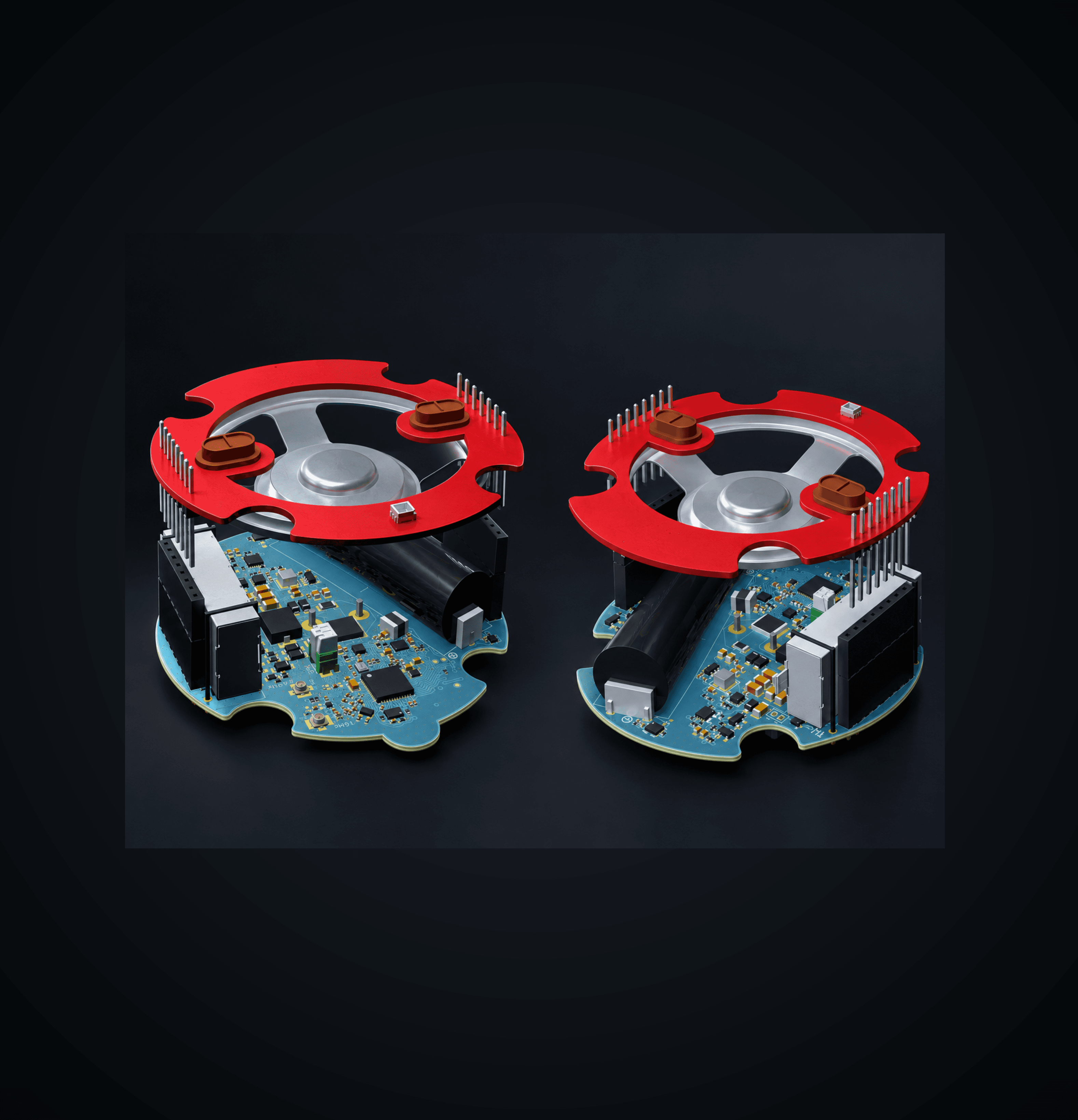
We built the button's firmware on TI-RTOS running on a Texas Instruments wireless MCU, splitting its two communication jobs across two separate radios rather than overloading one link with both: Bluetooth Low Energy talks directly to the traffic controller - the same controller board in this platform that carries its own BLE radio for exactly this - sending each request-to-walk press the moment it happens, while a dedicated Sub-1 GHz radio talks button to button, so every push-button installed around the same intersection forms its own local wireless network with its neighbors instead of each button being visible only to the controller. The board is built compact enough to sit directly behind the tactile dome button standard on these installations, with the dome switch mounted straight onto the board so a pedestrian's press has nothing but a short mechanical throw between it and the radio.
Results
The result is a pedestrian button whose request reaches the controller, and whose presence is known to every other button on its intersection, without a dedicated data wire run to either. Because it was designed against the same controller board's own BLE and Sub-1 GHz radio pair rather than a generic wireless link, the button and the controller were built to fit each other from the start, and an intersection's full set of buttons can be commissioned, replaced, or added to as a wireless group instead of a point-to-point wiring exercise for each one.
Kick-start your project
Get in touch with our team to discuss your business needs and see how we can help with a project like this one.