
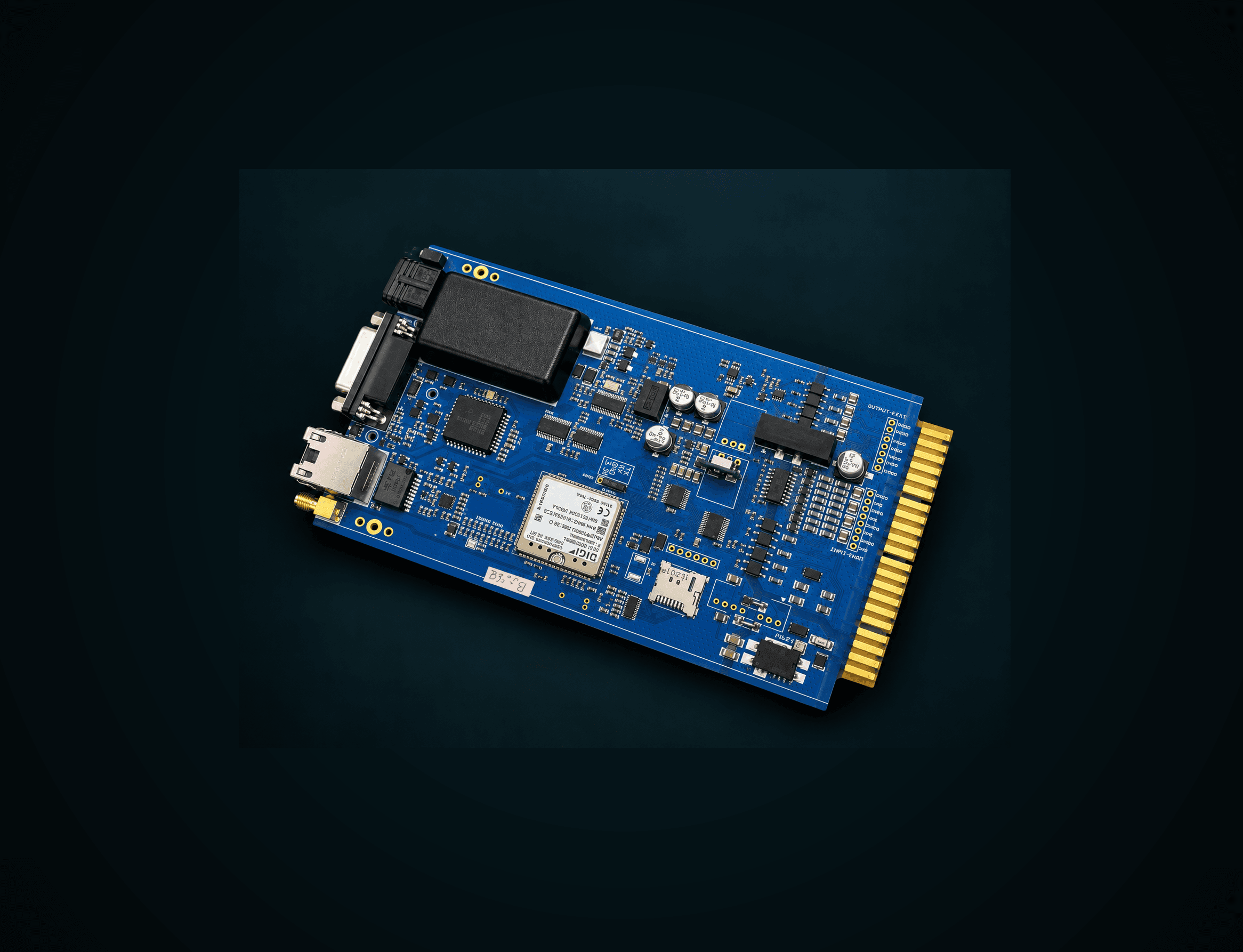
Designing a SOM-based traffic signal controller board bridging legacy cabinet interfaces to modern connectivity
Challenge
A client needed to modernize a traffic-signal controller while keeping it compatible with existing traffic-cabinet infrastructure: the legacy PLCC-style front-panel interface and SDLC serial bus that a huge installed base of NEMA-style traffic cabinets and field equipment already use, while adding the processing headroom, memory, and connectivity a modern controller needs - Ethernet for the traffic-management network, USB-C for local commissioning, Wi-Fi and Bluetooth for maintenance access, and a low-power wireless link out to detectors or remote field devices.
Solution
We designed the controller around a Variscite DART-6UL system-on-module built on an NXP i.MX 6UltraLite processor, so the client got a modern, pin-compatible compute core without owning the SOM's own hardware and software bring-up, wrapped in a custom carrier board that speaks the traffic cabinet's own language: an SDLC interface for the serial bus still commonly used to talk to detector and cabinet interface modules, and a PLCC-style front-panel connector in the layout tradition of legacy NEMA controllers, so the board can take the place of an older unit in cabinet hardware that predates it. Alongside that legacy path, we added the connectivity a modern controller actually needs day to day: Ethernet for the traffic-management network, USB Type-C for local commissioning and diagnostics, and a dual-radio wireless host microcontroller combining sub-1 GHz for long-range, low-power links out to field devices with 2.4 GHz Wi-Fi and Bluetooth Low Energy for on-site maintenance and configuration access. We laid the board out in Altium Designer and modeled its enclosure in SolidWorks, so the electrical and mechanical design of the unit were developed together rather than the board being handed off to someone else to fit into a box.
Results
The result is a traffic controller that upgrades the compute, memory, and connectivity of an aging platform without breaking compatibility with the cabinet infrastructure it has to plug into - the legacy SDLC and PLCC-style interfaces stay intact while Ethernet, USB-C, Wi-Fi, Bluetooth, and a long-range sub-1 GHz radio bring the unit up to a modern connectivity standard. Building it on a proven SOM meant the client's own design effort went into the traffic-specific carrier board and its interfaces rather than re-deriving an i.MX6 reference design from scratch, and developing the electrical and mechanical design side by side gave them a controller that was engineered to fit its enclosure from day one instead of being adapted to it afterward.
Kick-start your project
Get in touch with our team to discuss your business needs and see how we can help with a project like this one.